

Quarterly Record-Keeping for UK Sole Traders and Landlords
Quarterly Record-Keeping for UK Sole Traders and Landlords
Running your own business or managing rental properties comes with a key responsibility: keeping accurate financial records. To meet Making Tax Digital (MTD) requirements for 2026–28 filings, quarterly record-keeping is essential. The good news is that recording details regularly, rather than scrambling at year-end, makes the whole process simpler and gives you clearer insight into your financial performance.
What Records You Need to Keep
Whether you're a sole trader or a landlord (or both), you need to track several types of financial information. Let's break down the main categories:
Income Records
Record every pound earned from your business or rental activity. This includes sales revenue, service fees, rental income, or any other money generated. Keep supporting documents: invoices, payment confirmations, and bank statements. Online payments and bank transfers are easier to evidence than cash, but if you receive cash, keep records of it too.
Expenses
Business expenses include materials, supplies, equipment, software, professional services, insurance, advertising, and office costs. Landlords track repairs, maintenance, letting agent fees, insurance, and property-related costs. Keep receipts—digital photos or scans are acceptable—for all business spending.
Property Records (for Landlords)
If you own multiple rental properties, track income and expenses separately for each one. This makes tax filing clearer and shows you which properties are performing well financially.
Mileage Records
If your work involves travel—meeting clients, visiting sites, managing properties—mileage is typically tracked. Keep a log: date, location, distance, and purpose of the journey. A spreadsheet is ideal for this, and updating it regularly beats trying to reconstruct it from memory later.
Why Quarterly Record-Keeping Matters
It's tempting to leave financial records until the end of the tax year, but quarterly reviews offer real advantages:
- Easier to remember: Transactions from three months ago are fresher in your mind than those from twelve months.
- Spot patterns: Quarterly totals reveal trends in your income or spending, so you can make adjustments if needed.
- Less year-end stress: Your year-end records are nearly complete before you start.
- Compliance-ready: Quarterly records align with Making Tax Digital requirements for 2026–28.
Common Record-Keeping Mistakes to Avoid
Here's what catches people out:
- Mixing personal and business money: Keeping them separate makes records clear and easier to evidence.
- Losing receipts: Digital photos of receipts work, but you need them. Don't assume you'll remember.
- Forgetting small expenses: A client coffee, office pen, small delivery—these add up. Record them.
- Leaving records unorganized: A scattered folder of papers or email attachments is harder to work with than a simple system.
- No backups: If your computer fails, you lose your records. Keep copies.
Building Your Quarterly Record System
A spreadsheet is one of the most practical ways to manage quarterly records. You can log income and expenses as they happen, categorize them, track properties separately if needed, and log mileage—all in one document. Calculations happen automatically, so at the end of each quarter your totals are ready.
The advantage of a spreadsheet is control: you set it up to match your business. Multiple properties? Use separate tabs. Heavy on mileage? Make that section detailed. The key is regularity: update weekly or fortnightly, not monthly or quarterly.
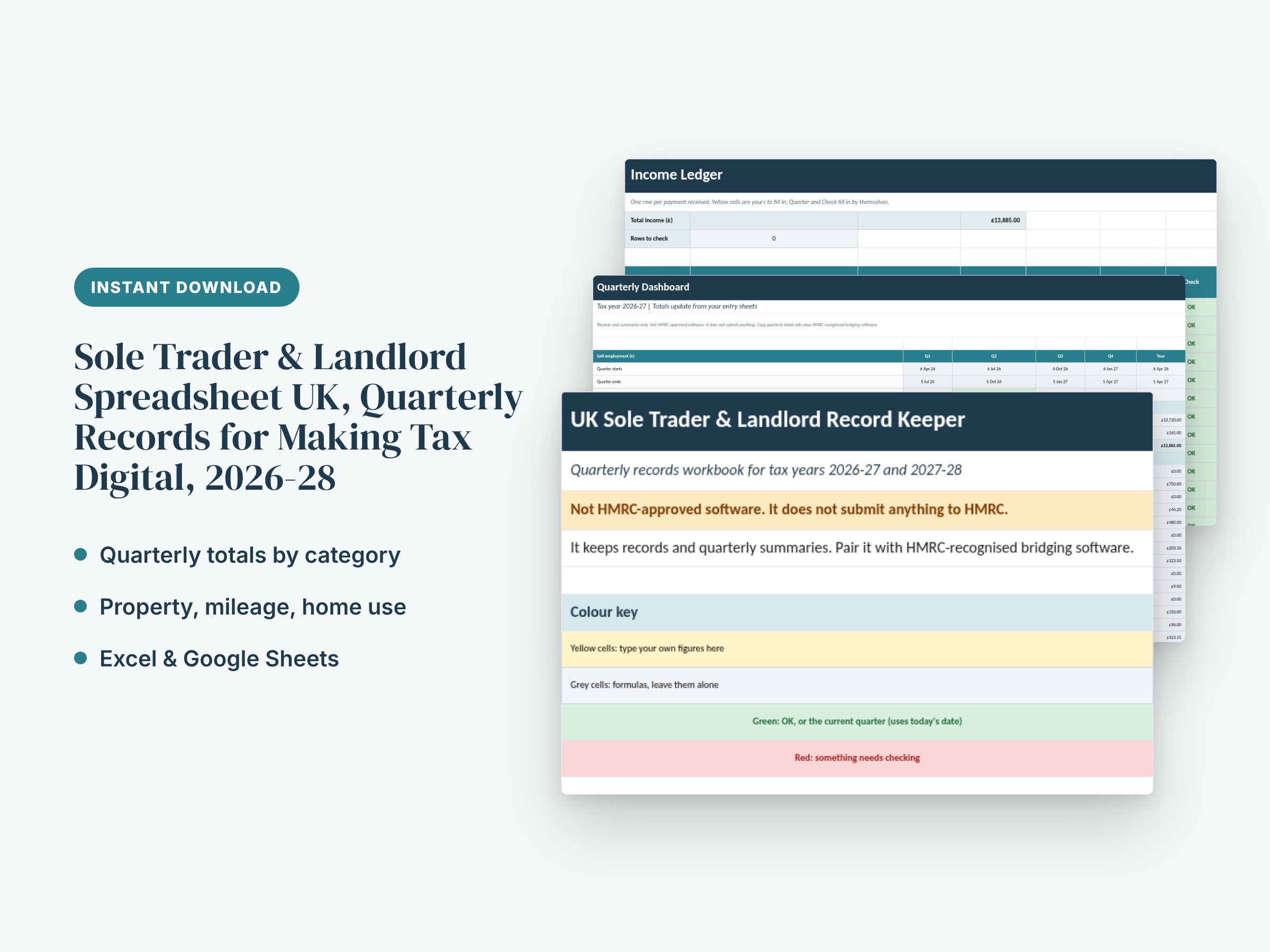
If you're designing a spreadsheet from scratch, a template saves time and ensures you're not missing important sections. A template built for UK sole traders and landlords—one designed for quarterly MTD reporting and covering income, expenses, property, and mileage—takes the guesswork out of structure and categories.
Get Started
You don't need expensive accounting software or professional bookkeeping to keep good records. A clear system and a practical structure now will make your quarterly filings and year-end tax preparation straightforward.
Try a ready-made spreadsheet template created for UK sole traders and landlords. It covers quarterly records, income, expenses, property, and mileage, and works in both Excel and Google Sheets. Start your quarterly record-keeping this quarter.
Save time: Sole Trader & Landlord Spreadsheet UK, Quarterly Records for Making Tax Digital, 2026-28 is ready to download and use today.
Stay in the loop.
New templates and member-only offers, now and then. No spam. Unsubscribe in one click.