

Practical Guide to Remembrance Day Worksheets
For educators looking to incorporate Remembrance Day activities into their Year 5 and Year 6 classrooms, this guide provides a practical introduction to using the provided worksheets. Each activity is designed to engage students while teaching them about the historical significance of Remembrance Day and the bravery of soldiers during World War II.
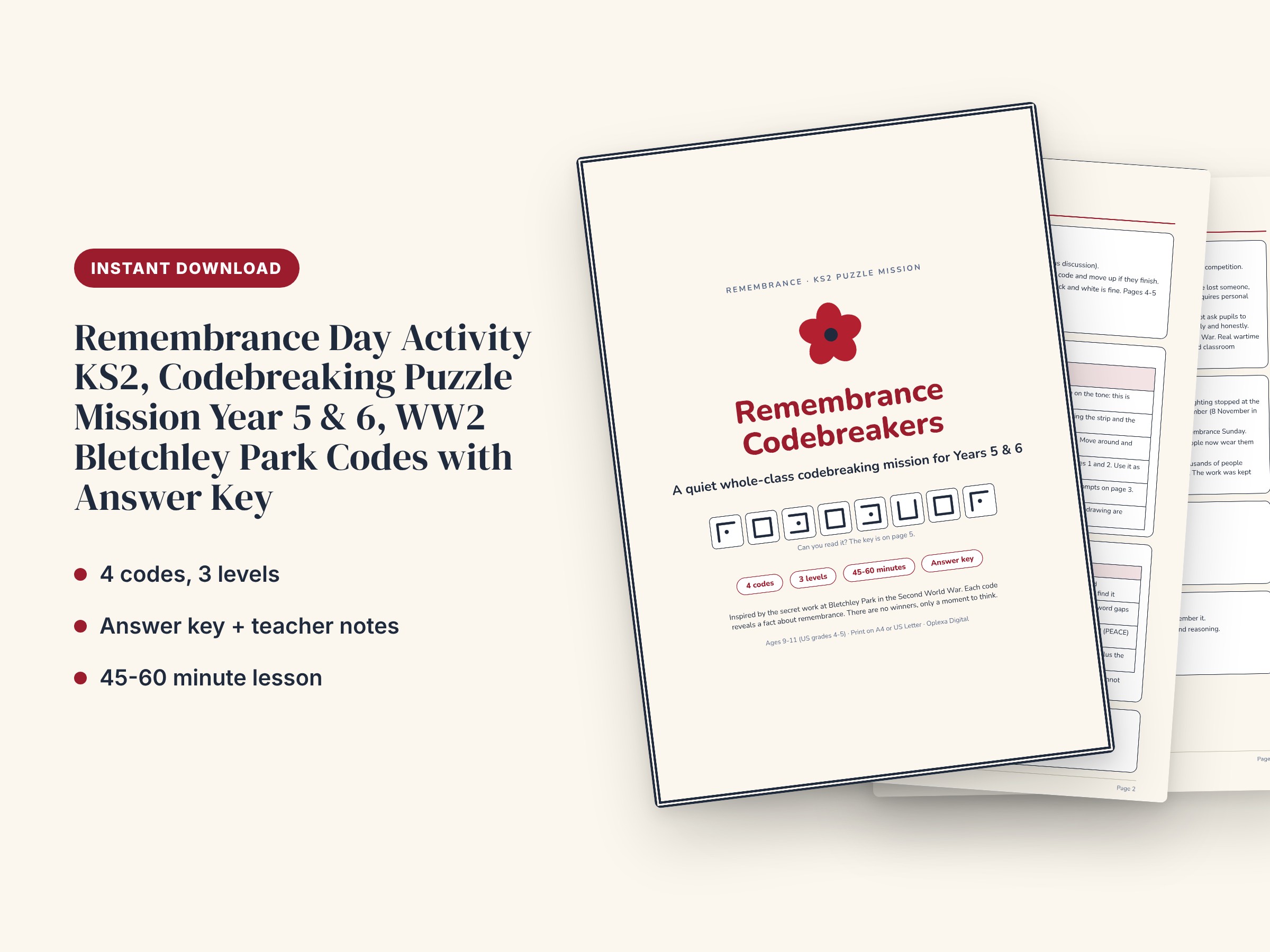
Remembrance Day Activity KS2
Overview
The Remembrance Day Activity KS2 is an 11-page document designed for Year 5 and Year 6 students. It features a codebreaking mission with four different ciphers, three levels of difficulty, and teacher notes to assist in classroom use.
Steps to Implement
- Preparation:
- Ensure students have a basic understanding of codes and cryptography.
- Review the teacher notes to understand the context and objectives of each cipher.
- Familiarize yourself with the answer key to ensure correct grading.
- Instruction:
- Begin by introducing the concept of Remembrance Day and its historical significance.
- Explain what a code is and why it was important during World War II.
- Introduce the four ciphers, providing a brief history of each one.
- Activity Execution:
- Divide students into small groups and assign them to the different levels of the cipher.
- Provide the first cipher sheet and ensure students have the necessary materials (paper, pencil, eraser).
- Guide students through the first level of each cipher. Encourage them to use the answer key if they get stuck.
- Gradually increase the difficulty as students progress through the levels.
- Assessment:
- Use the provided answer key to check the students' work.
- Provide feedback and encourage discussion on what they discovered about the historical context.
- Reward successful completion with certificates or extra credit.
Codebreaking Puzzle Mission Year 5 & 6
Overview
The Codebreaking Puzzle Mission Year 5 & 6 is a 11-page printable document that includes a codebreaking mission with three different puzzles, designed for Year 5 and Year 6 students. It includes teacher notes and an answer key to help guide the classroom use.
Steps to Implement
- Preparation:
- Ensure students have a basic understanding of codes and the importance of codebreaking during World War II.
- Review the teacher notes to understand the context and objectives of each puzzle.
- Familiarize yourself with the answer key to ensure correct grading.
- Instruction:
- Begin by introducing the concept of codebreaking and its importance in World War II.
- Explain what the puzzles are and how they relate to the codebreaking mission.
- Introduce the three puzzles, providing a brief history of each one.
- Activity Execution:
- Divide students into small groups and assign them to the different puzzles.
- Provide the first puzzle sheet and ensure students have the necessary materials (paper, pencil, eraser).
- Guide students through the first puzzle, encouraging them to use the answer key if they get stuck.
- Gradually increase the difficulty as students progress through the puzzles.
- Assessment:
- Use the provided answer key to check the students' work.
- Provide feedback and encourage discussion on what they discovered about the historical context.
- Reward successful completion with certificates or extra credit.
WW2 Bletchley Park Codes with Answer Key
Overview
The WW2 Bletchley Park Codes with Answer Key is a 11-page document that includes historical codes and messages from Bletchley Park, the British codebreaking center during World War II. It includes teacher notes and an answer key to guide classroom use.
Steps to Implement
- Preparation:
- Ensure students have a basic understanding of codes and the importance of codebreaking during World War II.
- Review the teacher notes to understand the context and objectives of the codes and messages.
- Familiarize yourself with the answer key to ensure correct grading.
- Instruction:
- Begin by introducing the concept of Bletchley Park and its role in World War II.
- Explain what the codes and messages are and how they relate to the codebreaking mission.
- Introduce the historical context and significance of Bletchley Park.
- Activity Execution:
- Divide students into small groups and assign them to the different codes and messages.
- Provide the first code and ensure students have the necessary materials (paper, pencil, eraser).
- Guide students through the first code, encouraging them to use the answer key if they get stuck.
- Gradually increase the difficulty as students progress through the codes.
- Assessment:
- Use the provided answer key to check the students' work.
- Provide feedback and encourage discussion on what they discovered about the historical context.
- Reward successful completion with certificates or extra credit.
Conclusion
These worksheets and classroom printables are designed to engage students and provide a meaningful learning experience about Remembrance Day, codebreaking, and the history of Bletchley Park. By following these practical steps, educators can effectively incorporate these resources into their curriculum, ensuring that students not only learn about history but also develop critical thinking and problem-solving skills through interactive activities.
Save time: Remembrance Day Activity KS2, Codebreaking Puzzle Mission Year 5 & 6, WW2 Bletchley Park Codes with Answer Key is ready to download and use today.
Stay in the loop.
New templates and member-only offers, now and then. No spam. Unsubscribe in one click.