

How to Budget for UK Household Costs in 2026
How to Budget for UK Household Costs in 2026
October 2026 brings new energy price caps that will affect how much you pay for gas and electricity. If you've been feeling the impact of rising utility bills, creating a proper household budget is more important than ever. This guide will help you understand your costs, track your consumption, and plan for the year ahead.
Why Your Household Budget Matters Right Now
UK energy prices change quarterly—in October, January, and April. These aren't random; they're based on wholesale costs and set by the regulator. Understanding these cycles helps you anticipate when your bills will rise or fall, and plan your spending accordingly. Beyond energy, most households juggle rent or mortgage, council tax, groceries, transport, and insurance. A proper budget brings all these together so you can see where your money actually goes—and more importantly, where you have choices.
Start by Understanding Your Energy Usage
The first step is to know how much energy you actually use. This means reading your gas and electricity meters regularly. Most people check their bills once a month, but by reading your own meters at the same time each month, you can:
- Spot unusual spikes in usage that might signal a problem
- See which seasons cost more (typically winter for heating)
- Verify the numbers on supplier invoices
- Make informed choices about energy use (insulation, appliances, habits)
Monthly meter reading logs take just two minutes but provide months of useful data. Write down your readings on the same day each month—this gives you consistent, comparable figures. Over time, you'll develop a realistic picture of your consumption patterns rather than relying on estimates or outdated information.
Calculate Your Baseline Costs
List everything you pay for regularly. These are expenses that happen every month or every quarter, regardless of your choices:
- Rent or mortgage
- Council tax
- Water and wastewater
- Gas and electricity (use recent bills or current price cap rates)
- Insurance (home, contents, pet, any other)
- Phone and internet
- Transport (public travel season ticket, fuel, car costs)
These are your fixed and semi-fixed costs. They don't change dramatically month to month, but energy bills certainly will as you move through the price cap quarters. By knowing these figures, you'll understand what portion of your income is committed before you spend anything on groceries or entertainment.
Plan for Energy Price Cap Changes
Energy price caps adjust in October, January, and April. When the new rates come into force, your direct debit will typically change too. Rather than being caught off guard, calculate what each quarter will cost at its respective price cap. If you know January will be colder and you'll use more heating, budget slightly higher for that month. This way, your winter sinking fund—money set aside specifically for expensive months—isn't a surprise you scramble to cover, it's a plan you've already made.
Add Variable Spending
After baseline costs come the things that vary week to week: groceries, transport fuel, clothes, gifts, entertainment, subscriptions, and unexpected repairs. Look at what you spent over the last three months and calculate a realistic monthly average. Be honest—if you spend £40 on coffee some months, budget for it rather than pretending you won't. This makes your budget achievable rather than demoralizing, because it's based on reality, not fantasy.
Compare Plan to Reality
A budget only works if you check it regularly. Every month, compare what you planned to spend against what you actually spent. The key question isn't "did I spend exactly right?" but "where were the gaps, and why?" If your actual spending is higher than expected, you can adjust future months. If it's lower, you can save the difference or reallocate it to something else.
Use a Tool That Works for You
Pen and paper works for some people, but a spreadsheet makes comparisons across months much easier. You can set up columns for budgeted versus actual spending, add formulas to calculate totals, and create simple charts to see your spending patterns at a glance. A spreadsheet also lets you update it the moment you check your meter or receive a bill, keeping everything current and accessible.
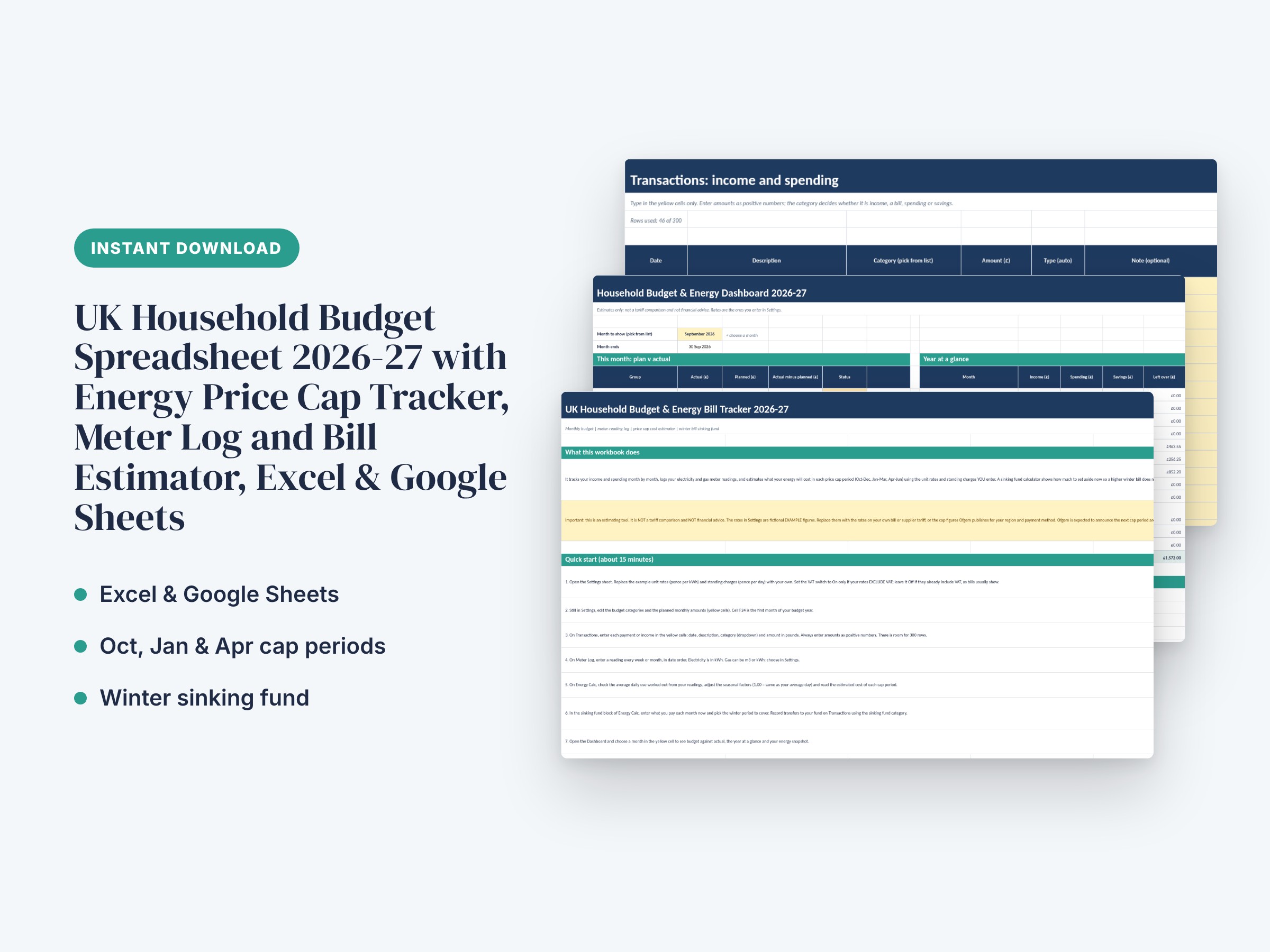
If you want a ready-made structure with meter reading logs, price cap cost estimation, and a monthly dashboard all set up, the UK Household Budget Spreadsheet for 2026-27 includes all these features in Excel or Google Sheets. It's designed specifically for the October, January, and April price cap cycles and helps you build a sinking fund for the months you know will be expensive.
Review Quarterly
When the price cap changes in January and April, take 15 minutes to review your budget. Update your estimated energy costs, check whether your discretionary spending has changed, and adjust your sinking fund if needed. Small reviews prevent the shock of realizing in March that you've overspent or can't cover winter bills.
Start Today
October is an ideal time to begin. The new price cap is in force, you can read your meters fresh, and you have three months until the next change to settle into a routine. Budgeting isn't about restricting yourself; it's about knowing your money, making choices that align with your priorities, and avoiding surprises.
If you're ready to build a structured household budget that accounts for UK energy price changes, get started with a budget spreadsheet template and you'll have everything in place by the end of the week.
Save time: UK Household Budget Spreadsheet 2026-27 with Energy Price Cap Tracker, Meter Log and Bill Estimator, Excel & Google Sheets is ready to download and use today.
Stay in the loop.
New templates and member-only offers, now and then. No spam. Unsubscribe in one click.