

Year 1 Phonics Screening Check: How to Prepare Your Class
Understanding the Year 1 Phonics Screening Check
The Year 1 Phonics Screening Check is a key assessment in UK Key Stage 1 literacy. Children are asked to read aloud a list of 40 words—some real words and some pseudo words (nonsense words that follow phonics rules). Teachers play a recording that sets the pace, and children have three seconds to respond to each word.
This check measures whether children can apply their phonetic knowledge to decode unfamiliar words, which is a crucial reading skill. It's designed to be straightforward but does require children to stay focused and demonstrate their phonic knowledge under a little pressure.
Why Practice Matters
Most children perform better when they've encountered the format before. A practice check does several things:
- Familiarises children with the rhythm and pace of the real check
- Builds confidence by reducing anxiety about an unknown test
- Reveals which phonics phases each child has truly mastered
- Shows you which children may need extra intervention before the real check
- Allows you to identify common mistake patterns, like substitution errors or hesitation points
Running multiple practice checks across the term gives you reliable data on progress and helps you time your interventions effectively.
Managing the Pseudo Word Challenge
Many children find pseudo words harder than real words because they can't rely on sight recognition or context. A child who can read a familiar word fluently might hesitate over a nonsense word because they've never encountered it before.
Help your class by:
- Practising pseudo words in isolation first. Give children time to blend and decode nonsense words during regular phonics sessions before they encounter them in a check format.
- Explaining the concept clearly. Tell children that some words in the check will be "pretend words" that follow phonics rules but aren't real English words. This removes the surprise and reduces frustration.
- Using your practice checks strategically. If most children struggle with pseudo words in an early practice check, that's information telling you to build this into your phonics teaching before the next one.
- Celebrating effort. Remind children that pseudo words are meant to be tricky, and getting them right shows strong phonics skills.
Setting Up Effective Classroom Practice
When you run a practice check, replicate the real conditions as closely as possible. Use the timing guidance, play the recording at the correct pace, and mark answers consistently. This gives you the most accurate picture of how each child will perform.
A simple tracker helps you spot patterns across your class. For example, you might notice that three children consistently struggle with Phase 3 words, or that certain blends are areas of weakness across your group. This data points directly to what you need to teach or revisit.
Keep practice checks low-stakes. Children perform better when they know a practice check is a learning tool, not a judgment. Frame it positively: "This helps us see what we're great at and what we'd like to get even better at."
Targeted Intervention
After your first practice check, you'll have a clear picture of which children need extra support. Rather than generic phonics revision, intervention should target the specific phases or phoneme-grapheme correspondences where each child is struggling.
Short, focused sessions work best. Even 10 minutes daily with a child or small group, targeting their specific gaps, produces real progress. Keep resources simple and word-focused rather than worksheet-heavy—children need to blend and read, not mark paper.
Timing Your Practice Checks
Spread your practice checks across the term. A pattern that works well for many teachers is:
- Two checks in autumn term, once children have learned Phase 2-3
- Two in spring term
- Two in summer term, with the final one very close to the actual check
This pacing gives you time to act on the data between checks and builds children's confidence gradually.
Get Your Practice Materials Ready
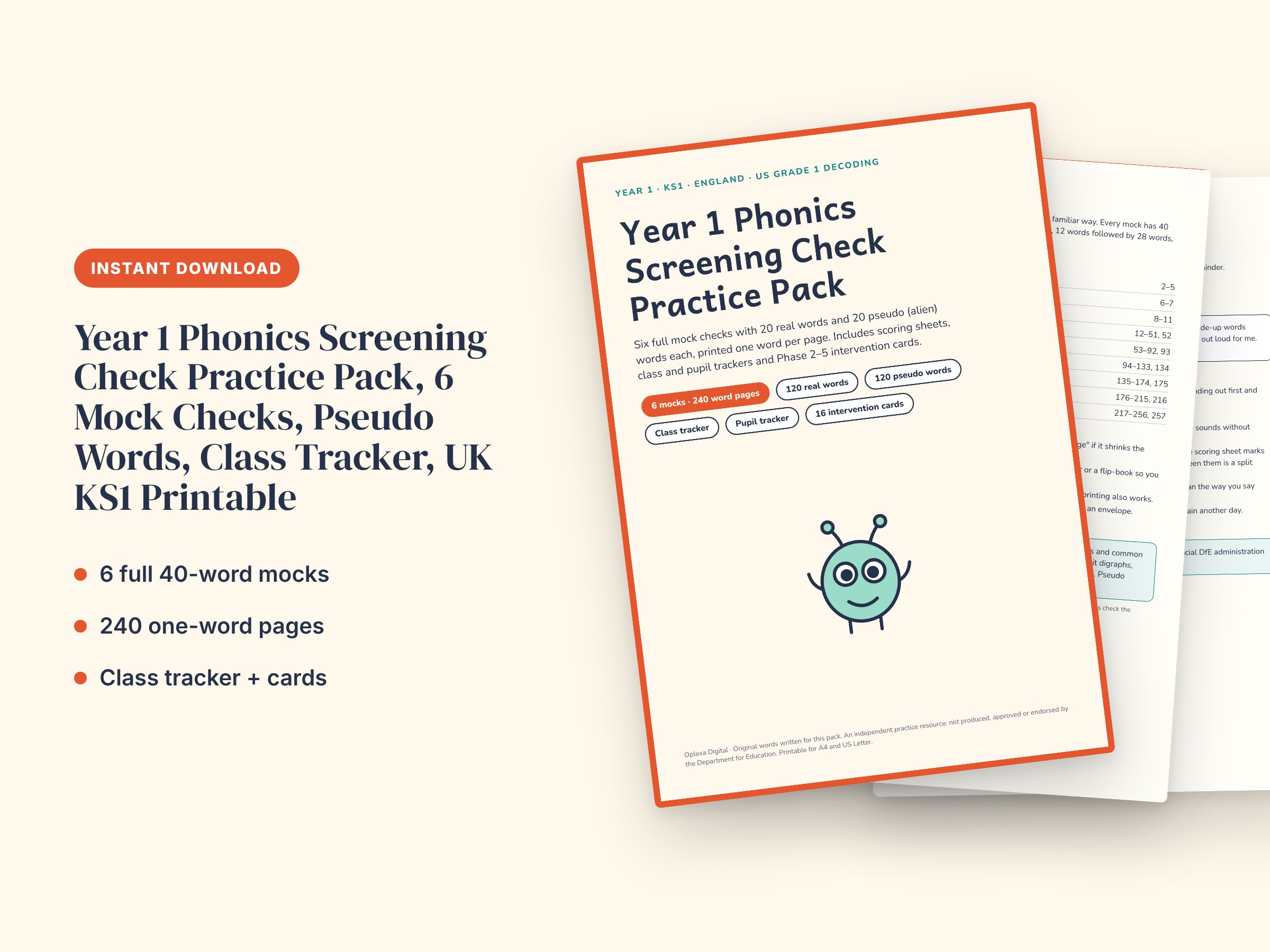
If you're preparing your Year 1 class for the phonics screening check, having multiple mock checks ready saves planning time and lets you focus on teaching. Our Year 1 Phonics Screening Check Practice Pack includes six ready-made checks with both real and pseudo words, scoring sheets for quick marking, and a class tracker to record progress over time.
Start your practice checks early, keep them regular, and use the data to guide your teaching. With consistent preparation and targeted support, the vast majority of your Year 1 class will be ready for the real assessment.
Save time: Year 1 Phonics Screening Check Practice Pack, 6 Mock Checks, Pseudo Words, Class Tracker, UK KS1 Printable is ready to download and use today.
Stay in the loop.
New templates and member-only offers, now and then. No spam. Unsubscribe in one click.